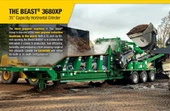
Drum-style tree chippers are robust,industrial-grade machines designed for demanding wood processing tasks.They employ a rotating cylindrical drum equipped with blades to efficiently and continuously draw and chip wood.Unlike disc-style chippers,which cut with a spinning disc,the drum chipper's aggressive,rolling action is exceptionally effective at processing large,irregular,or knotty material.Selecting the ideal drum chipper for your operation involves a careful assessment of your specific needs,the nature of the material you'll process,and your long-term operational goals.
The first step is a thorough evaluation of your own needs.Consider the primary application:are you a municipal crew clearing storm debris,a logging operation processing slash,a biomass facility preparing feedstock,or a large-scale arborist service?The answer dictates scale.Next,analyze the material.What is the typical diameter and species of wood?Drum chippers excel with large-diameter hardwoods,whole trees,and mixed,dirty,or crooked wood.Also,quantify your required production volume-whether it's tons per hour or total weekly output.This will directly influence the necessary power and machine size.Finally,consider operational logistics:do you need a highly mobile tow-behind unit for various job sites,or will a stationary setup at a processing yard suffice?
Capacity and Power:The chipper's maximum intake diameter(e.g.,12",18",24")must exceed your typical material size.For heavy,hard,or dirty wood,opting for a machine rated 25-30%above your average diameter provides a safety margin and prevents overworking.Engine horsepower(HP)correlates directly with throughput and torque.Smaller operations may manage with units in the 60-175 HP range,while industrial applications often require 200-500+HP.Matching power to your expected volume ensures efficiency and longevity.
Feed System and Mobility:Most drum chippers feature hydraulic feed systems with infeed rollers.Look for systems with variable speed control and enough power to pull in large,irregular logs without constant operator intervention.Portability is crucial for many.Compact,road-towable models offer great flexibility,but ensure your towing vehicle has adequate capacity.Larger,trailer-mounted or truck-mounted configurations prioritize high-volume production at the cost of some mobility.
Chip Quality and End Use:The intended use for the output chips is critical.Drum chippers typically produce a slightly less uniform chip than high-end disc chippers,which can be perfect for biomass fuel,boiler fuel,or landscaping mulch.If you require extremely consistent,high-quality chips for pulp,panel board,or animal bedding,discuss your specifications with the manufacturer,as knife configuration and screen options can influence chip size and consistency.
Durability,Safety,and Support:These machines endure tremendous stress.Inspect the build quality:a heavy-duty,reinforced drum,solid steel construction,and quality components are essential.Never compromise on safety.Ensure the machine has comprehensive guarding,emergency stop systems,a feed reversal function,and lockout/tagout points.Finally,consider the manufacturer's reputation for reliability,the availability of spare parts,and the quality of local dealer support and service.A well-supported machine minimizes costly downtime.
Drum Chipper vs.Disc Chipper:A Practical Perspective
While this guide focuses on drum chippers,understanding the alternative is vital.Disc chippers,which use a large spinning steel disc with knives,are renowned for producing very uniform chips and are often preferred for precision applications like pulp mills.They are generally more efficient on clean,straight softwoods.Drum chippers,however,are the workhorses for challenging material.Their rotating drum generates tremendous inertia and a powerful,continuous pulling action,making them superior for processing large logs,stumps,branched material,and wood contaminated with dirt or sand.They are often considered more forgiving and robust in harsh,high-volume environments where material consistency is not guaranteed.
After defining your needs and comparing specifications,take these final steps.If possible,arrange a demonstration using your own typical material.This is the best way to evaluate real-world performance,chip quality,and ease of operation.Analyze the total cost of ownership,not just the purchase price.Factor in estimated fuel consumption,routine maintenance costs,knife wear and replacement,and potential financing.A slightly more expensive but more efficient and durable machine can offer a better long-term return on investment.
Choosing the right drum-style tree chipper is a significant investment that impacts your productivity,safety,and profitability.By methodically assessing your requirements against the machine's capabilities and prioritizing durability and support,you can select a chipper that becomes a reliable asset for years to come,transforming challenging wood waste into valuable,manageable product.
How To Choose The Right Drum-style Tree Chipper For Your Needs?
Apr 10, 2026
ایک پیغام چھوڑیں۔
شاید آپ یہ بھی پسند کریں